How to Choose a Haircut for Your Face Shape: A Men's Guide
The same haircut can look completely different on two people — and the reason is often face shape. Here's a look at the five main face shapes, and the cuts that work with your features instead of against them.
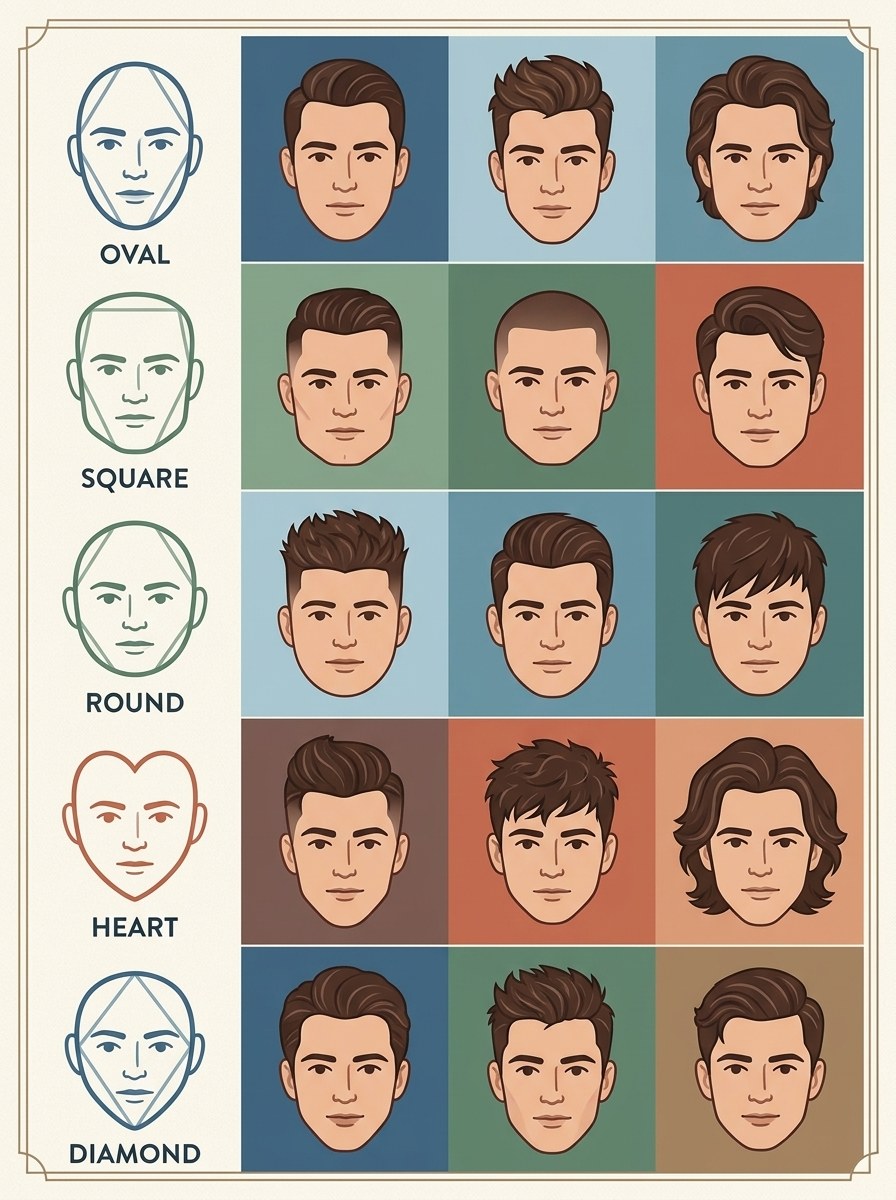
How to figure out your face shape
Stand in front of a mirror, pull your hair back, and look at the proportions: where is your face widest — at the forehead, cheekbones, or jaw — and what's the shape of your chin: rounded, pointed, or angular? Compare the length of your face (hairline to chin) with its width at the cheekbones.
Not sure? No problem — a barber can spot your face shape in a few seconds during a consultation and tell you which cut will suit your features best.
Oval face
Oval is the most balanced shape: the forehead, cheekbones, and jaw are roughly the same width, and the face is slightly longer than it is wide. It's a near-universal base — almost any cut works.
- Textured crop
- Pompadour
- Side part
- Quiff
- Fade at any height — low, mid, or high
- Short buzz cut
- Avoid: a heavy, texture-less fringe that covers the whole forehead — it flattens the natural balance an oval already has
Square face
A defined jawline, broad forehead, and angular lines are the main markers of a square face. The goal of the cut is to soften those angles slightly by adding volume on top.
- Textured crop with volume on top
- Pompadour
- Side part
- Quiff
- Fade with a soft, not-too-short top
- Avoid: a very short buzz cut or a flat top — both just emphasize the squareness of the jaw
Round face
The cheeks are the widest point, the lines are soft, and length and width are roughly equal. The cut's job is to add height and angularity to visually lengthen the face.
- High fade with volume on top
- Pompadour
- Quiff or faux hawk
- Textured crop with height on top
- Avoid: round, full styles with no defined shape, a center part, and a short buzz cut all over — these add width, not height
Oblong face
The face is noticeably longer than it is wide, with a narrow jaw and straight cheek lines. Here it's the opposite of a round face — the cut should add width and shorten the visual length, not add more height.
- A cut with volume on the sides
- A fringe that shortens the forehead
- A medium-length textured crop with a fringe
- A side part with a fringe
- Avoid: tall pompadours, quiffs, and slicked-back styles with no fringe — they only stretch the face further
Heart-shaped face
A wide forehead and cheekbones taper down to a narrow, pointed chin — the classic heart shape. The cut should take the focus off the forehead and add volume lower down.
- A side-swept fringe that covers part of the forehead
- A medium-length textured cut with volume at the bottom
- A soft fade with no hard contrast
- Avoid: a fully slicked-back style with no fringe, and a very short buzz cut — both emphasize a wide forehead and cheekbones
Ready for a cut that fits?
Face shape is just a starting point — the final call always depends on your hair's density and texture, your beard style, and what's realistic for you to maintain day to day. The best way to find your cut is a consultation — the barber will assess your face shape in person.
Want a cut built for your face shape?
Our barber will assess your face shape in person and find the cut that works for you.
Book a haircut